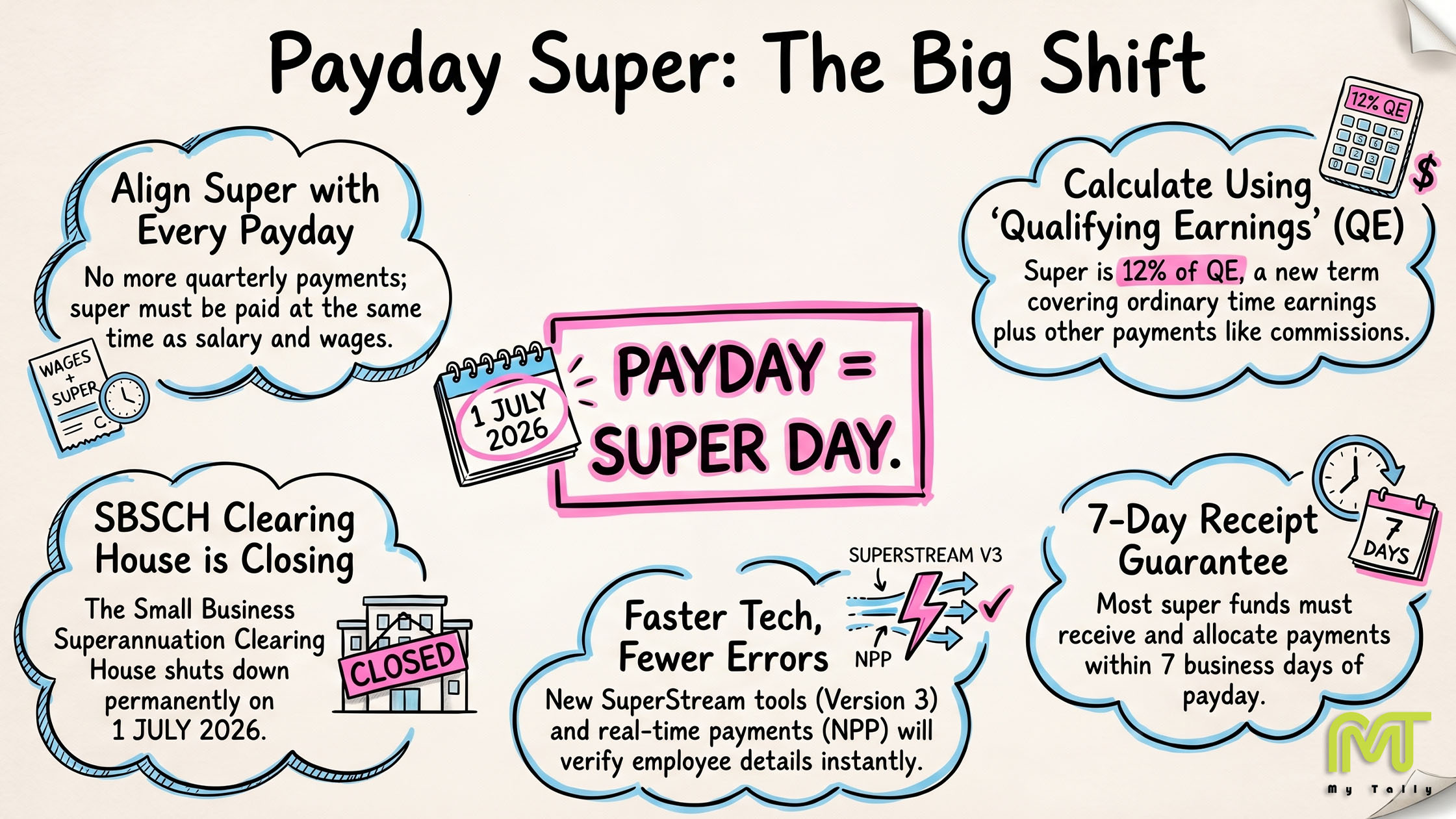
If you work in Australia, superannuation is your hard earned money saved for your future. But have you ever noticed that while your wages hit your bank account every week or fortnight, your super takes much longer to show up in your fund?
Big changes are coming to fix that. Starting 1 July 2026, the Australian Government is introducing Payday Super, a new system that will change how and when your super guarantee (SG) is paid. Here is what you need to know about the new rules and how they will benefit you.
💸 Goodbye Quarterly, Hello Payday
Right now, employers are allowed to pay your super quarterly, sometimes meaning your money isn't received by your super fund until 28 days after the end of a quarter.
With the launch of Payday Super, your employer will be required to pay your super guarantee at the same time as your salary and wages. By law, these contributions must be received by your super fund within 7 business days of your payday.
⚡ Faster Payments and Fewer Errors
Because of these changes, your money will be put to work for your retirement much faster. Thanks to the New Payments Platform (NPP)- a real-time payments platform used across Australia- super payments made through payroll systems could be received by your super fund on the same day your employer makes the payment.
The systems employers use to process super are also being upgraded. New "member verification requests" will allow payroll software to instantly check that your super fund details are valid before the money is sent. This drastically reduces the chance of your money bouncing back or being delayed due to an error.
📊 How Much Will You Get? Introducing "Qualifying Earnings"
From 1 July 2026, your super will be calculated as 12% of your Qualifying Earnings (QE).
For most employees, the new concept of Qualifying Earnings won’t actually change the amount of super you receive, but rather serves as a new, simplified base for calculating it.
What is included in your Qualifying Earnings?
- Your ordinary hours of work
- Casual loading and shift penalties (including public holiday penalties)
- Leave types like annual leave, sick leave, personal/carers leave, and paid rostered days off
- Commissions
- Salary sacrificed to superannuation
What is NOT included?
- Overtime payments
(Note: Independent contractors who are paid mainly for their labour are also considered employees for super guarantee purposes and will fall under these new rules.)
✅ What Do You Need to Do?
The good news is that the heavy lifting for Payday Super falls on employers, who are currently upgrading their payroll software to prepare for the 2026 transition.
However, there is one critical thing you can do to help: Make sure your employer has your correct super fund details. Employers are being urged to check that they have up-to-date member account numbers and unique superannuation identifiers (USI) for all eligible employees to prevent payment errors. If you've recently changed super funds, make sure to give your employer your new details so your Payday Super flows into your account without a hitch!
Source: Australian Taxation Office (ATO)